

An Evolution From Theory to Practice
A shift towards a unified framework for re-animating a sense of sacred participation within nature, ritual & lived experience
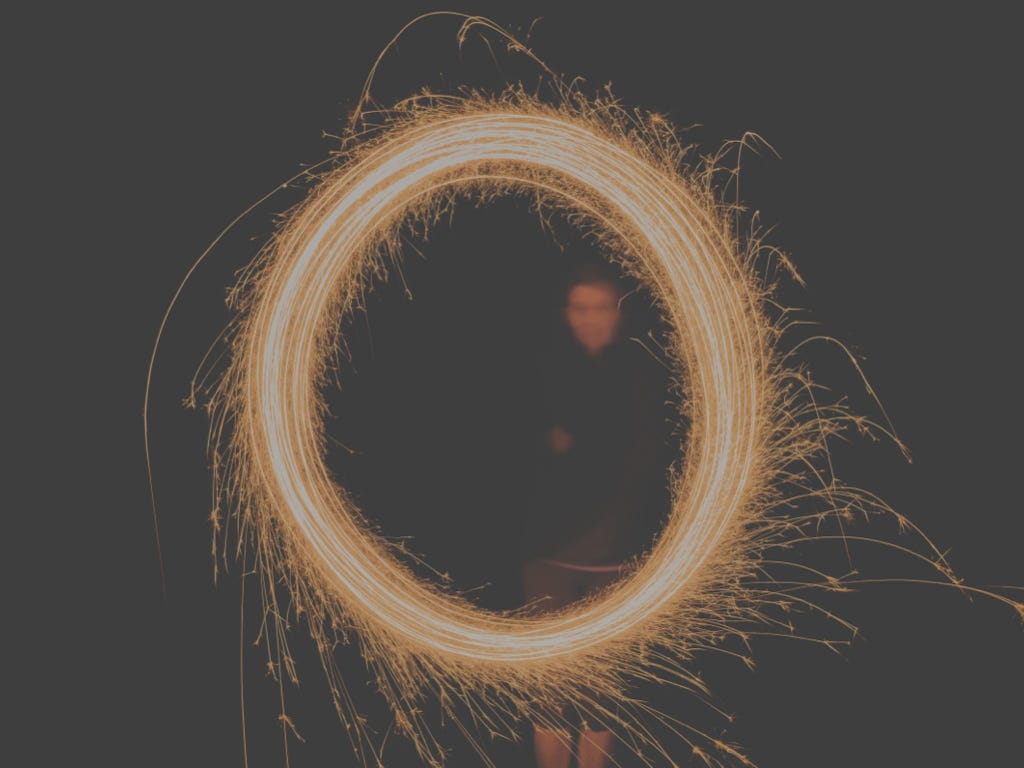
“Physicists shy from the truth because the truth is so alien to everyday physics. A common way to evade the mental Universe is to invoke “decoherence” — the notion that “the physical environment” is sufficient to create reality, independent of the human mind. Yet the idea that any irreversible act of amplification is necessary to collapse the wave function is known to be wrong… The Universe is entirely mental.”
— Excerpt Of “The Mental Universe” Richard Henry —
◦ The Science ◡
I’ve talked about this a lot. For me there was a moment, not a dramatic one but an important moment nonetheless, where the way I’ve been taught to understand the world in which we live is not quite right. It felt slightly… insufficient.
Not wrong, exactly. Just incomplete.
Materialist models of mind and reality always felt structurally incomplete. Neuroscience, physics, and psychology offered increasingly elegant descriptions of how systems behave, but they never quite accounted for the edge cases that refused to stay peripheral. Experiences like terminal lucidity, near-death states, mystical absorption, and other anomalous forms of cognition suggested that consciousness could not be fully reduced to local brain activity. Not as proof of anything definitive, but as persistent irregularities in the model.
They led me first into formal study of cognition and perception, and then outward into other explanatory frameworks that treated consciousness less as a byproduct and more as something fundamental.
Early on, I was drawn to holographic and systems-based models of reality. Bohm’s implicate/explicate order, Pribram’s holographic brain, and Sheldrake’s morphic resonance all pointed toward the same underlying possibility: that reality behaves less like a collection of separate objects and more like an interconnected informational field. In that framing, apparent separation is not fundamental, but perspectival. Each part is embedded in the whole.
At the same time, the phenomenology of consciousness added further weight to this direction of thinking. Across cultures and contexts, reports of non-ordinary states — terminal lucidity, near-death experiences, and deep contemplative absorption — consistently pointed toward a loosening or dissolution of the usual perceptual filter. These states did not behave like random neurological noise; they appeared structured, often characterised by heightened coherence, clarity, and interconnectedness.
Slowly, an idea began to form. We live in a consciousness-first holographic universe where:
Consciousness is fundamental and from which matter and energy emerged
Material reality is a system of coherent resonance patterns with the whole pattern is present everywhere
Consciousness creates shared patterns of resonance of localised coherence
These three ideas are behind the basis of a conscious-holographic universe.
◦ The Wyrd ◡
In parallel, I began studying the philosophies and traditions of the Spiritualists and the New Agers, the Hermeticists and the Theosophists, the Celtic Pagans and the Nordic Heathens.
For me it was important to remind myself that ancient peoples didn’t live in a culture or time that had the same scientific language as I do. If they had to describe something as “scientific” as a consciousness-first universe, they would be limited to describing it in terms of their subjective experience, and using concepts that are within their language. It would be limited to metaphors and parables, like the allegory of Plato’s cave.
Regardless, within all of these traditions similar patterns emerged. There are, of course, many nuances among these traditions due to idiosyncratic differences in cultural, sociopolitical, and linguistic factors, but I’m by far also not the first to have noticed a theme that spans all of the esoteric cosmologies. This idea of a primordial tradition has been called the secret wisdom, the forgotten truth, the ancient theology, the prisca theologia, and so on. In modern times it’s called Perennial Philosophy, and was popularised in modern times by British novelist Aldous Huxley in his 1945 book by that title. It posits that there is a single, underlying mystical cosmology from which all of the various religious traditions of the world have emerged.
Anyway, I digress.
They described correspondence, attention, transformation, and inner alignment in ways that felt operational rather than merely mythological, and also somehow familiar. And when we focus on the similarities, we find that three simple ideas keep popping up:
Consciousness is fundamental and it is primary over the physical world.
Everything is interconnected.
There is only one Consciousness.
Almost universally, those three ideas from the foundations of magic.
See a Similarity?
Over time, the threads between the scientific models, the phenomenology, and the perennial philosophy became intertwined, and started taking shape in my mind as a single working framework: A consciousness-first holographic universe that is participatory and structurally responsive to focussed attention and intention.
Up till now, the focus has been architectural: the quantum brain, the nature of reality, the nature of mind and matter, etcetera, etcetera, etcetera... That work matters because it established the foundations of the framework and rooted it in something real and scientific.
But it isn’t, nor should it be, the endpoint. A framework like this can remain entirely abstract, or it can become something that useful.
That is the direction my work is moving in now.
What follows is a shift away from treating this as something to be analysed and explained, towards treating it as something to be used and lived. Less emphasis on explanation, and more on application and usefulness.
I will be exploring what this framework looks like in practice: how it reframes perception, how it alters engagement with symbolic systems, and how coherence becomes something that can be worked with directly rather than merely understood. A framework that can be applied within magickal rituals and practices such as force-of-will magic, divination or theurgy. A framework from which to understand Psi and paranormal phenomena, OBE’s and NDE’s, pre-sentience and precognition, synchronicities, remote viewing, telepathy…
You get the idea.
So for those of you who are here purely for the science, this will probably feel like a departure. It is.
But for those of you who have been waiting for something beyond the scaffolding — something that actually does something — this is where it begins to take shape. Not as answers, but as process.
I am not interested in positioning myself as a teacher, or a guide, or anything particularly formal. This is not that kind of project. It is, at its core, a record of a line of inquiry that has been running for most of my life, now turning outward in a more practical direction — a lived exploration rather than a theoretical one.
If any of it resonates, take it as an invitation rather than a conclusion.
Test it. Break it. Use what holds.
Because if this framework is even partially accurate, then it might be worth giving it a try.
◦ ◦ ◦ ◦ ◦
DISCLAIMER: ◦ wyrd ◡ science ◦ is a proudly human-made publication and a 100% AI free. Every word is mine (and so is every grammar and spelling mistake!). Thank you for being here for it!
Reclaim Your Place in a Conscious Cosmos
Explore a growing library of works designed to help you understand how attention, intention, and structure interact so you can move from passive observer to conscious participant in how your reality unfolds.
wyrd ◡ science ◦ is supported by its readers. If you’d like to contribute, you can subscribe, upgrade, or make a one-off donation. And if this essay gave you pause, pass it on — these conversations grow through people, not algorithms.